AI-Driven Growth: Transforming Marketing & Sales Operations at Flip
As Flip entered a rapid growth phase, the demand for personalized marketing assets and custom sales materials far outpaced the capacity of the design team. I designed and implemented an automation strategy that shifted the workflow from manual "pixel-pushing" to an agent-led generation engine, backed by a design foundation.
Design & Automation Architect
Ongoing
Software Development
Challenge
Flip faced primary friction points:
The Design Bottleneck: Standard marketing assets (ads, landing pages, webinar headers) required 40+ hours of manual design time per campaign.
Brand Entropy: As the team grew, manual checks failed to ensure that every asset across social, web, and sales was strictly compliant with the brand's evolving style guide.
Results
After developing the design foundation and implementing the automation strategy, we achieved:
Efficiency: Average production time for campaign assets dropped.
Sales Impact: Proposals that previously took 2 hours to draft are now generated in 5 minutes.
Quality: 100% of generated assets pass through a Langdock "Compliance Agent," resulting in zero brand violations.
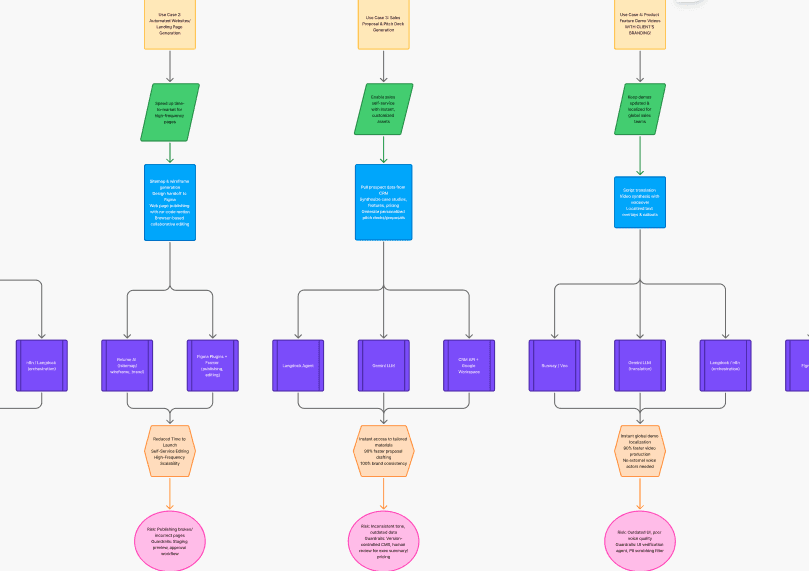
Process
The Web Creation Workflow (Relume + Figma + Framer)
Instead of traditional design-to-code cycles, I established a collaborative, browser-first workflow:
Sitemaps & Wireframes: Utilized Relume to generate AI-driven sitemaps and wireframes instantly.
Design Handoff: Used the Relume Figma plugin to apply the brand's style guide automatically.
No-Code Publishing: Sections were copied directly from Figma to Framer using their native plugin.
Collaboration: Leveraged Framer’s browser-based editing, allowing non-designers to edit copy and images directly in the browser, ensuring 100% autonomy for marketing teams.
Intelligent Orchestration (n8n + Langdock)
I utilized n8n as the "nervous system" to connect tools, while Langdock was used to develop specialized AI Agents:
Fact-Checking Agent: A Langdock agent that cross-references all AI-generated copy against a locked source-of-truth document to prevent hallucinations.
Proposal Generation Agent: An agent that pulls prospect data from the CRM and automatically assembles personalized pitch decks and proposals.
Governance Agent: An agent that audits Figma files daily to identify non-compliant components or outdated brand tokens.
Key Use Cases Implemented:
Dynamic Ad Creative: Scaled ad variations using Gemini and Midjourney.
Automated Webinars: landing page creation via Relume/Framer.
Personalized Proposals: CRM-triggered pitch deck generation.
Localized Demo Generation: Using Runway/Veo to create localized product walkthroughs.
Brand Governance: AI-led auditing of the design system.
Conclusion
The success of this project was not merely a result of choosing the right tools, but of having a deep understanding of core design principles and effectively codifying them into AI systems. By translating abstract brand values ( such as visual hierarchy, typographic consistency, and narrative tone) into structured data and agent instructions, we created a system that feels human but acts at machine scale.